
Turismo Regenerativo
Regenerative Tourism vs. Ecotourism: They Are Not the Same Thing (and Why the Difference Matters)
July 1, 2026
These days, almost every trip is marketed as “green”: eco-hotels, eco-tours, eco-lodges, sustainable glamping. The label has become so commonplace that it no longer means anything, and along the way, a distinction that really matters has been lost. Because a trip that promises not to cause harm is not the same as one that aims to leave a place better than it was found. That difference—almost invisible when you’re planning a trip—is the line that separates ecotourism from regenerative tourism. It’s worth understanding it before you decide where to go.
What Is Ecotourism (and Where Are Its Limits)?
Ecotourism was born out of good intentions: to travel to natural areas while minimizing impact, respecting wildlife, and educating travelers. It represents progress compared to extractive mass tourism, and we owe it a great deal. But the bar is set low. The goal of ecotourism, at best, is to do no harm: to leave the smallest possible footprint, to take only photographs, and to take nothing away.
The problem is twofold. First, “do no harm” has become a label that’s easy to claim but difficult to verify, and that’s where _greenwashing_ thrives. Second, and more fundamentally: in ecosystems that are already damaged, “do no harm” isn’t enough. When a place has lost half its life, keeping it as it is means freezing the loss, not reversing it. And many of our oceans are precisely in that state.
The True State of the Ocean (Why the “Do No Harm” Standard Is No Longer Enough)
The data is sobering. The planet’s live coral cover has been cut in half since the 1950s, according to a study published in One Earth and released by the Natural History Museum in London (NHM, 2021). During that same period, reef-associated biodiversity declined by more than 60%. And in fisheries, the most recent FAO assessment estimates that about 35% of marine fish stocks are overexploited, with overfishing increasing by nearly 1% per year (FAO, 2025).
Faced with an ocean like this, passive conservation is insufficient. It’s not enough to simply avoid causing damage—we need to repair it. That’s where another idea comes in.
What Is Regenerative Tourism
Regenerative tourism draws its framework from the regenerative economy, a concept that financier John Fullerton, a former executive at JPMorgan, articulated in 2015 in his essay Regenerative Capitalism (Capital Institute). His thesis is elegant: economic systems should mimic living systems, which do not merely sustain themselves but produce and regenerate in a single process. Nature does not “reduce its impact”; as a forest grows, it improves the soil, water, and air around it.
Applied to travel, regenerative tourism changes the question. It is no longer “How can I cause less harm?” but rather “How can I ensure that my presence leaves the ecosystem and the community better off than they were before?” The bar is raised from simply not causing harm to actually regenerating.
The key difference, in a sentence
Ecotourism seeks to leave the smallest footprint. Regenerative tourism seeks to leave a positive footprint. One measures its success by what it prevents; the other, by what it creates: protected hectares, species that are recovering, families who give up trawling because caring for the ocean provides them with a livelihood. It’s a difference in ambition, and that’s why it matters. On a planet still in the process of healing, aiming merely not to make things worse is aiming too low.
True Cost Accounting: Why the Extractive Model Only Seems Cheaper
There is an economic reason why the extractive model continues to prevail, and it has a name: it doesn’t pay for what it destroys. The framework of True Cost Accounting, developed by Pavan Sukhdev in the TEEB study for UNEP (2010), explains it clearly: an activity that depletes a mangrove forest, depletes a fishery, or bleaches a coral reef seems cheaper only because its price does not include the cost of that destruction. Someone pays for it later—almost always the local community and the ecosystem.
When those costs are internalized, the bill is reversed. The regenerative model, which at first glance seems more expensive, turns out to be the one that truly pays off, because it does not pass its bill on to the future. This is the basis of our thesis: the goal is not to refrain from intervening, but to conserve resources faster than they are extracted, aligning economic incentives with the health of the environment.

The Akampa Case: What Regeneration Looks Like, in Numbers
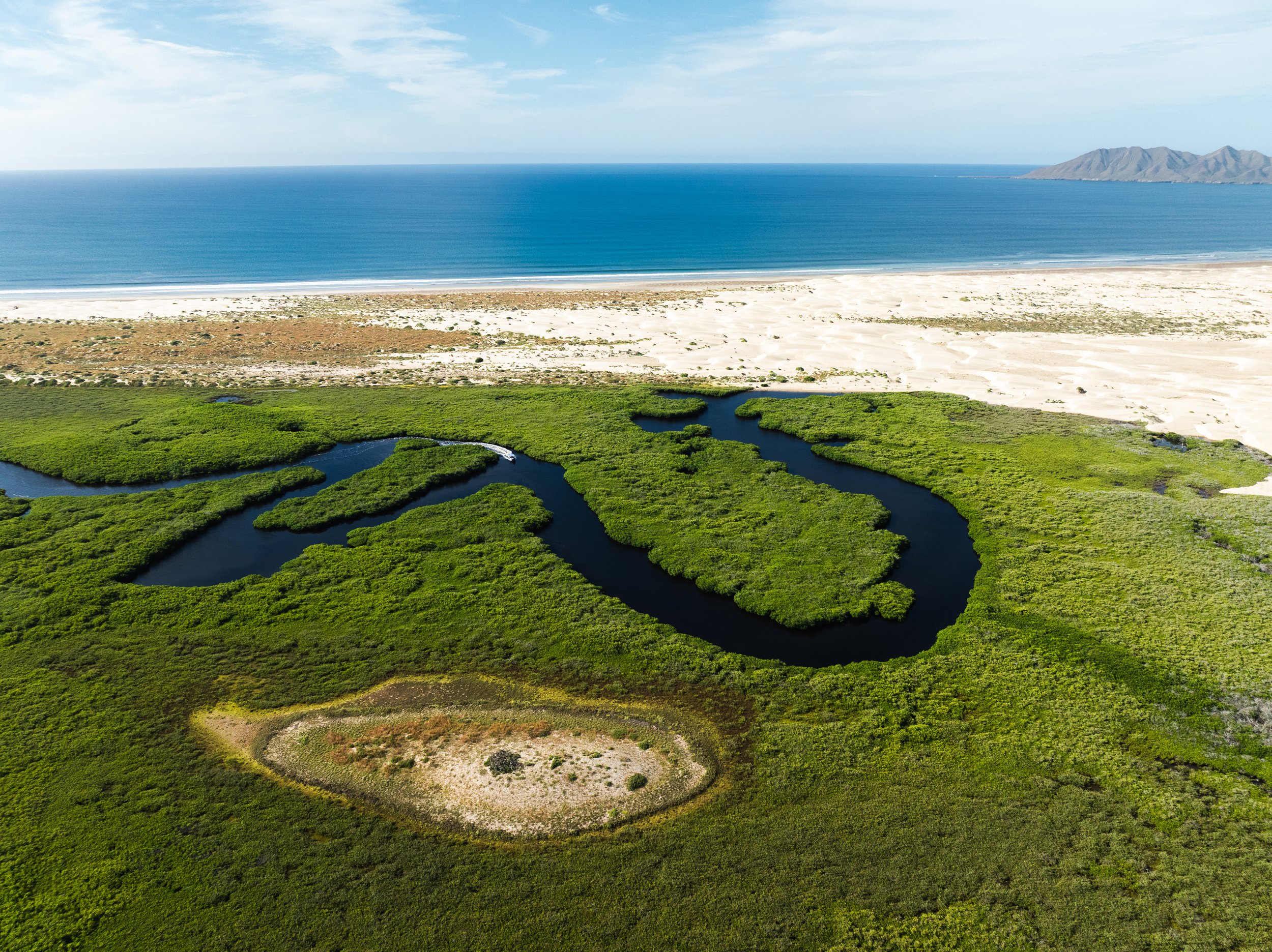
A theory without proof isn’t enough. Ours is being put to the test in Bahía Magdalena, Baja California Sur, where we’ve been operating under this model for about four years. We cover this in depth in our Bahía Magdalena guide, but here the numbers matter, because we believe that regeneration can be measured.
In 2025, our operation generated an economic impact of approximately MX$7.4 million for the local community, creating 13 direct jobs and 25 indirect jobs. We sorted approximately 70% of the waste and removed nearly 99% of the trash we found from the ecosystem. Our tents are a “take-down-and-reassemble” system: prefabricated, without foundations or poles, with a fully reversible setup that does not alter the soil structure. And we use maximum guest capacity and seasonality as deliberate conservation tools: the philosophy is to scale revenue without scaling impact.
None of these figures are perfect, and that’s precisely the point. They’re honest, measured, and published, because a regenerative model that isn’t accountable is just another form of greenwashing. Our roadmap aims for 100% solar energy and partnerships with scientific institutions in the coming years.
How to Recognize a Regenerative Trip (5 Key Questions)
If you’re deciding where to travel, these questions help distinguish what’s truly regenerative from what’s merely cosmetic:
- Who keeps the money? A regenerative trip generates direct, verifiable income for the local community, not just for an outside operator.
- Are there numbers, or just adjectives? If sustainability is advertised with fancy words but without a single measurable figure, be suspicious.
- Is the community the host or just window dressing? Look for locals who run the operations, make decisions, and benefit from them—not just those who appear in photos.
- Is the infrastructure reversible? What’s built to last forever is rarely low-impact.
- Are capacity and season intentionally limited? Deliberate scarcity is a sign that the place matters more than volume.
It’s the same logic we explored in our post on conservation tourism in Mexico: the label says nothing; the mechanism says it all.
Why This Distinction Matters So Much to Us
We emphasize the difference between regenerating and simply not causing harm because the future of the places we love hinges on it. If traveling merely prevents damage, the sea will continue to lose ground—perhaps more slowly, but it will still lose it. If traveling can regenerate, then every expedition becomes an economic vote in favor of intact nature being worth more than exploited nature. That’s the bet, and it’s verifiable.
You can learn more about our model and its figures on our Impact and About Us pages. And if you want to see it firsthand, our expeditions in the Sea of Cortez are the most direct way to turn your trip into conservation.